

It spots what your customers really mean — and finds value in what your business already knows. Fewer missed signals. More business.
A governed first layer before your team gets pulled in.
UK-based · Governed AI · Built for real service conversations
Built for UK service businesses across

Service businesses rarely lose time in one dramatic moment. They lose it in the first few exchanges.
It’s not lack of effort. It’s lack of control.
Servadra receives the customer conversation first. It reads the likely intent, checks approved knowledge, follows the business rules, and moves the conversation towards the right next step.
The value is not another chat window. It is a calmer, more controlled way to turn messy customer contact into structured next steps.
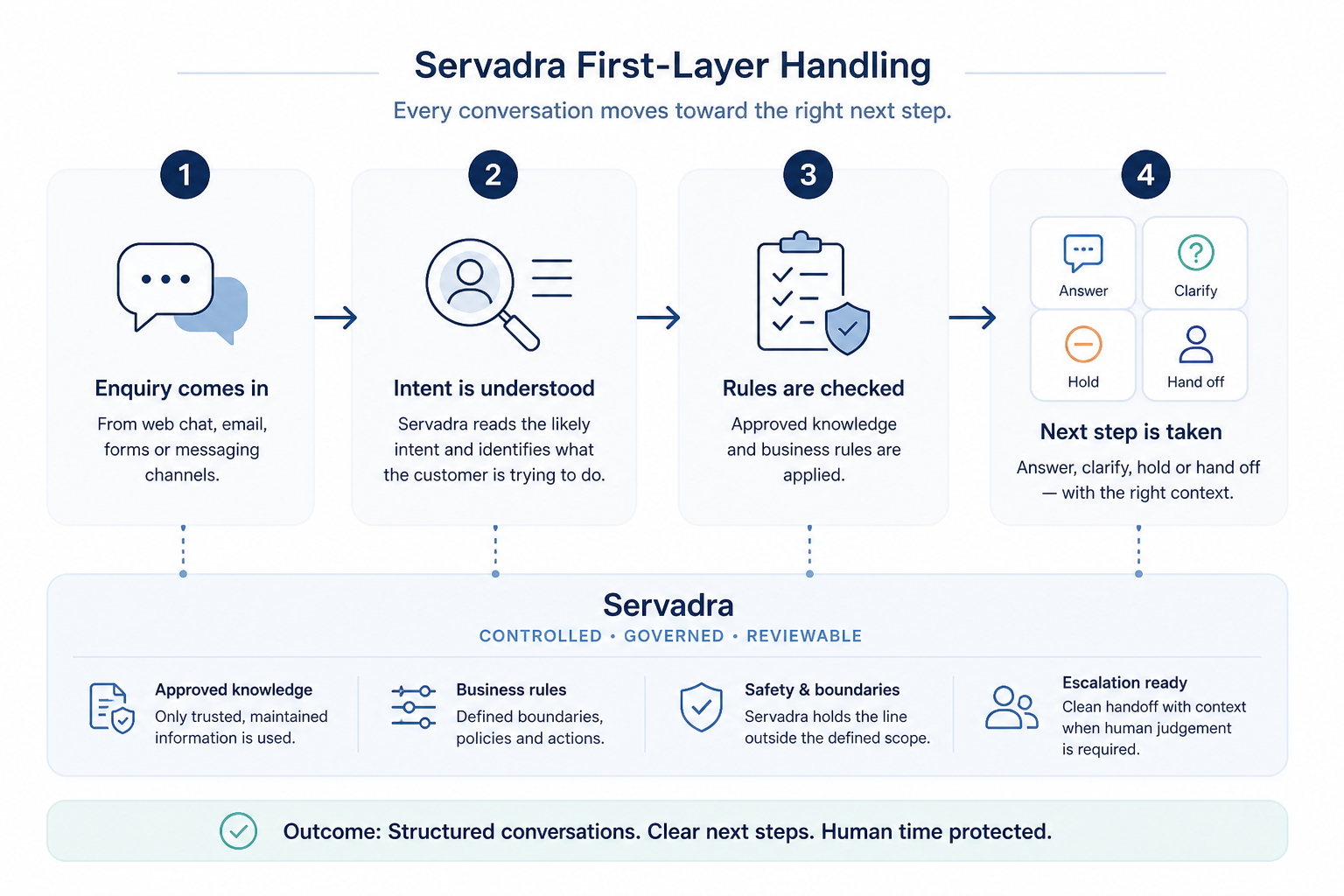
Servadra is built around governed answers, not free-form guessing. Each deployment works from approved knowledge, service boundaries, tone direction and handoff rules.
Servadra is built to stay inside approved knowledge and defined boundaries. When a question needs judgement, the system prepares the handoff instead of pretending to decide. Your team keeps control of the rules, the knowledge and the final decision.
This is how AI becomes usable in a real service business: helpful enough to reduce pressure, controlled enough to protect trust.

Clearer enquiries
Customers arrive with more structure before your team steps in.
Better handoff
Your team sees intent, urgency, requirements and suggested follow-up.
More control
Answers stay inside approved knowledge, defined boundaries and human handoff rules.

Servadra is built for service businesses dealing with messy first-contact. Whatever your angle, there is a clearer path from here.
Work with clients who need more structure around enquiries or follow-up? See how the Servadra Partner Programme works →
Simple service businesses can still have messy first enquiries. If customers ask what you offer, how support works, or what the next step is, clearer replies can save your team from repeating the same basics. You don't need a complicated operation before enquiry handling becomes worth improving. For example, a business with straightforward services may still lose time when customers send vague questions like "can you help with this?" A better first reply can collect the conversation into something more useful and keep customers moving. Your business doesn't have to be complex. It just needs enough customer contact for unclear handling to waste time. If that sounds familiar, the fit is worth discussing.
Simple service businesses can still have messy first enquiries. If customers ask what you offer, how support works, or what the next step is, clearer replies can save your team from repeating the same basics. You don't need a complicated operation before enquiry handling becomes worth improving. For example, a business with straightforward services may still lose time when customers send vague questions like "can you help with this?" A better first reply can collect the conversation into something more useful and keep customers moving. Your business doesn't have to be complex. It just needs enough customer contact for unclear handling to waste time. If that sounds familiar, the fit is worth discussing.
Simple service businesses can still have messy first enquiries. If customers ask what you offer, how support works, or what the next step is, clearer replies can save your team from repeating the same basics. You don't need a complicated operation before enquiry handling becomes worth improving. For example, a business with straightforward services may still lose time when customers send vague questions like "can you help with this?" A better first reply can collect the conversation into something more useful and keep customers moving. Your business doesn't have to be complex. It just needs enough customer contact for unclear handling to waste time. If that sounds familiar, the fit is worth discussing.
Simple service businesses can still have messy first enquiries. If customers ask what you offer, how support works, or what the next step is, clearer replies can save your team from repeating the same basics. You don't need a complicated operation before enquiry handling becomes worth improving. For example, a business with straightforward services may still lose time when customers send vague questions like "can you help with this?" A better first reply can collect the conversation into something more useful and keep customers moving. Your business doesn't have to be complex. It just needs enough customer contact for unclear handling to waste time. If that sounds familiar, the fit is worth discussing.
Simple service businesses can still have messy first enquiries. If customers ask what you offer, how support works, or what the next step is, clearer replies can save your team from repeating the same basics. You don't need a complicated operation before enquiry handling becomes worth improving. For example, a business with straightforward services may still lose time when customers send vague questions like "can you help with this?" A better first reply can collect the conversation into something more useful and keep customers moving. Your business doesn't have to be complex. It just needs enough customer contact for unclear handling to waste time. If that sounds familiar, the fit is worth discussing.
Simple service businesses can still have messy first enquiries. If customers ask what you offer, how support works, or what the next step is, clearer replies can save your team from repeating the same basics. You don't need a complicated operation before enquiry handling becomes worth improving. For example, a business with straightforward services may still lose time when customers send vague questions like "can you help with this?" A better first reply can collect the conversation into something more useful and keep customers moving. Your business doesn't have to be complex. It just needs enough customer contact for unclear handling to waste time. If that sounds familiar, the fit is worth discussing.
You should not have to bend your business into an awkward shape. The service is there to support customer enquiry and support handling, not make every organisation follow the same script. You can start from how enquiries already arrive: repeated questions, unclear requests, support issues, and follow-up needs. If your normal flow involves customers asking vague questions first, the first response can help clarify rather than force a rigid route. For example, a loose message asking whether you can help can receive a practical first steer. You keep your way of working while adding more order at the front.
It is designed to work across different business styles rather than assuming a single fixed approach. Every organisation has its own way of handling enquiries, shaped by its services, customers, and internal processes. Instead of enforcing a rigid method, the system supports a structured way of handling communication that can adapt to how your business operates. This allows you to maintain your preferred way of working while improving consistency and clarity in how enquiries are managed.
Try the widget first. Speak to us when you are ready.