
Never miss another customer.
Your AI Business Rep represents your business 24/7, gives every customer one consistent answer, helps qualify enquiries, and hands serious buyers to your team.
What’s slowing your team down?
After-hours enquiries missed
Inconsistent answers between staff
Repetitive questions eating team time
Customers cannot clearly explain what they need
Follow-ups dropped
It’s not lack of effort. It’s lack of structure before the conversation starts.


What Servadra actually does
Represents — Represents your business consistently, day and night — even when an enquiry arrives at 11pm.
Clarifies — Helps customers explain what they actually need — turning a vague question into a useful brief.
Protects — Stays within your approved Business Brain — holding anything uncertain for a human instead of guessing.
Hands Over — Passes the right context to the right person — so your team starts with a structured conversation, not an empty inbox message.
Every conversation leaves signals. Servadra captures them. SPOTS helps you understand them. Read More →
Teach it once. It answers correctly from then on.
Your Business Brain holds your services, prices and policies. Every answer Servadra gives comes only from this approved knowledge — never a guess.
Update your Business Brain from WhatsApp. Every change is checked before becoming approved knowledge.
One brain across your website, WhatsApp and Slack — one consistent message on every channel.
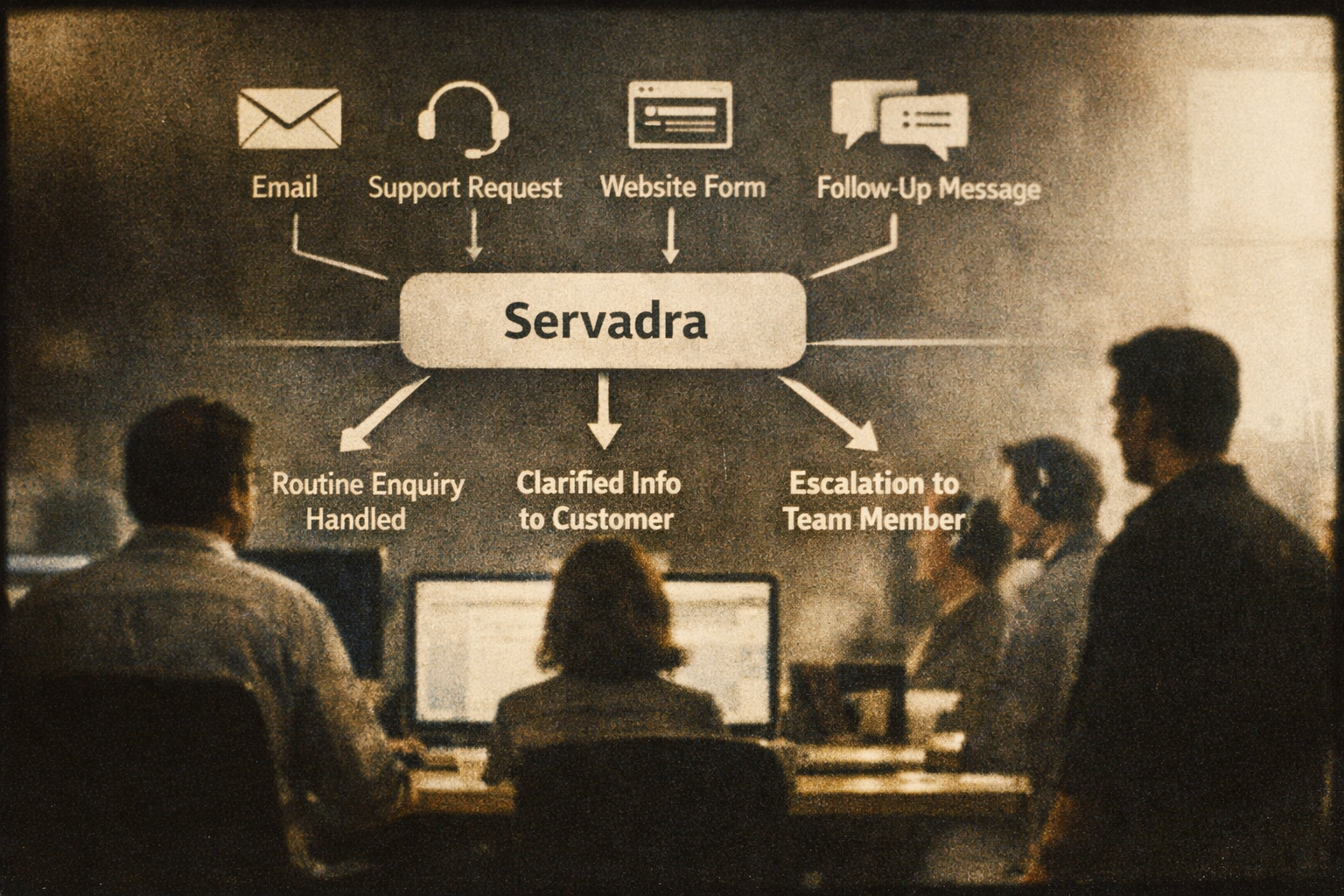
Governed AI vs. Standard Chatbot
Unlike a standard chatbot, Servadra doesn't guess.
Most chatbots answer with whatever sounds plausible — drifting off-topic, inventing answers, saying things your business never approved. Servadra works differently: every reply is governed by your own business rules and knowledge.
- Stays inside your business, on purpose. Only speaks to what your business has approved.
- No hallucinated answers. If Servadra doesn't know, it says so and hands off.
- Every conversation is auditable. You can see exactly why it said what it said.
- Built for the whole enquiry. Follow-up and after-sales included — not just the chat window.
That's the difference between a chatbot and a business rep.
You can’t improve what you can’t see.
Month 1 — See. Every enquiry is captured and visible, nothing missed.
Month 2 — Improve. Real data from real conversations sharpens the answers.
Month 3 — Optimise. Measured by business outcomes — enquiries handled, hours saved, buyers flagged — not by how often the AI replied.
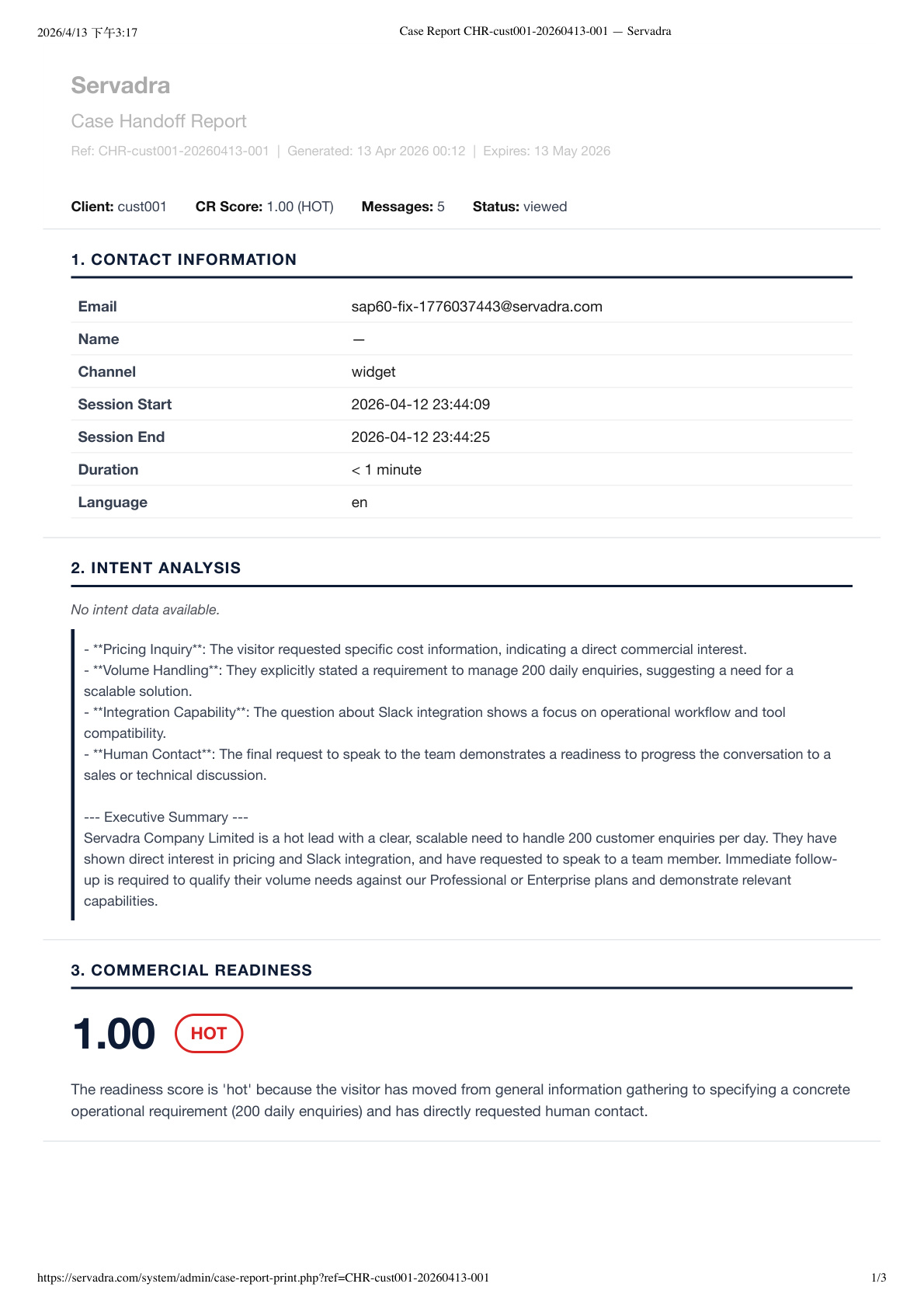
Example illustration only — not real customer data.
Why Servadra Exists
Built from experience, not hype.
Servadra wasn't created because AI became fashionable. It was created after more than 30 years building business systems and repeatedly seeing the same operational problems. Now those problems can finally be solved properly.
- Built from 30+ years of real business systems experience.
- Governed knowledge from your approved Business Brain
- Humans take over whenever needed.
- Measured by business outcomes, not AI activity.
Explore Servadra
Related Questions
Can we trigger automation when a new enquiry is received?
Yes. Automation can be triggered on a new enquiry where webhooks or integration automation are configured. We agree which events are emitted and what data is included in the trigger payload during onboarding.
Can we trigger automation when an enquiry reaches a certain stage?
Yes. Automation can be triggered when an enquiry reaches an agreed stage, where stage events are configured for your deployment. We confirm the stage definitions and the event rules during onboarding.
Is it capable of answering routine enquiries without my input?
Simple enquiries shouldn't need your attention every time. You can use prepared knowledge to handle the common questions your customers keep asking, so your team doesn't have to type the same answer again and again. If someone asks what happens after they make an enquiry, they can get a clear reply without waiting for you to pause your work. You still decide what information counts as safe and accurate, so the answer doesn't wander off into guesswork. The aim is simple: common questions get handled, while your time stays available for conversations that need judgement.
How is this better than alternative enquiry systems?
Usefulness comes from control plus practical relief. This handles customer enquiry and support conversations within your agreed business scope, so your team isn't relying on random wording or memory under pressure. If someone asks a common question, they can get a clearer response without waiting for a staff member to stop what they're doing. If a conversation becomes more important, your team can review the detail and follow up properly. That combination matters. You get fewer routine interruptions without losing sight of the enquiries that may need human attention.
Can it answer simple enquiries without me stepping in?
Simple enquiries shouldn't need your attention every time. You can use prepared knowledge to handle the common questions your customers keep asking, so your team doesn't have to type the same answer again and again. If someone asks what happens after they make an enquiry, they can get a clear reply without waiting for you to pause your work. You still decide what information counts as safe and accurate, so the answer doesn't wander off into guesswork. The aim is simple: common questions get handled, while your time stays available for conversations that need judgement.
Will it deal with simple customer questions without me having to step in?
Simple enquiries shouldn't need your attention every time. You can use prepared knowledge to handle the common questions your customers keep asking, so your team doesn't have to type the same answer again and again. If someone asks what happens after they make an enquiry, they can get a clear reply without waiting for you to pause your work. You still decide what information counts as safe and accurate, so the answer doesn't wander off into guesswork. The aim is simple: common questions get handled, while your time stays available for conversations that need judgement.
Can it manage straightforward queries without me needing to intervene?
Simple enquiries shouldn't need your attention every time. You can use prepared knowledge to handle the common questions your customers keep asking, so your team doesn't have to type the same answer again and again. If someone asks what happens after they make an enquiry, they can get a clear reply without waiting for you to pause your work. You still decide what information counts as safe and accurate, so the answer doesn't wander off into guesswork. The aim is simple: common questions get handled, while your time stays available for conversations that need judgement.
Why would this be more effective than other tools for handling enquiries?
Usefulness comes from control plus practical relief. This handles customer enquiry and support conversations within your agreed business scope, so your team isn't relying on random wording or memory under pressure. If someone asks a common question, they can get a clearer response without waiting for a staff member to stop what they're doing. If a conversation becomes more important, your team can review the detail and follow up properly. That combination matters. You get fewer routine interruptions without losing sight of the enquiries that may need human attention.
Customer asks → Servadra qualifies → You close.
Try the widget first. Speak to us when you are ready.
Everyday Business Moments
Small conversations. Better business outcomes.
"A buyer hiding in routine questions."
→ Recognised and prioritised.
"Price change on a Tuesday."
→ Updated from your phone. No stale quotes.
"11pm enquiry."
→ Qualified before breakfast.
"“Can I speak to someone?”"
→ The right person, with the full story attached.